New Forests is selling them, World Bank just had a big conference about them [1]; and they’re involved in scandals aplenty.
Carbon credits have been around since the 1997 Kyoto Protocol but are still controversial. Some argue that carbon credits are a “valuable opportunity” for companies to reduce their carbon pollution [2]. And certainly carbon credits have become increasingly visible in national and international climate policy. Not least, carbon is now a multi-billion dollar business – valued at over US$104 billion in 2024 [3].
But issues of integrity in the making of carbon credits, selling, and maintaining a carbon-reducing asset for the long term, proliferate.
This post digs into carbon credits to seek a basic understanding of what they are and how they work. A second blog considers whether they are a genuine strategy for carbon mitigation and adaption for the health sector.
Q&A
Like many topics on this blog, when I first came into contact with carbon credits I was totally befuddled by what they are and how they work. So let’s get some basics.
First, What is a Carbon Credit?
This sounds like a simple question, but the answer depends on who’s answering. If you are in science or some environmental sectors, carbon credits are about REMOVAL – a carbon credit is one metric ton of carbon dioxide that is has been permanently removed from the atmosphere or prevented from being emitted [e.g., 4, 5]. Note the emphasis on permanent. For others, the duration of carbon removal is significantly less than permanent in many registries (e.g. UK Woodland Carbon Code sells carbon credits that claims to store carbon for 40 years).
But if you are in financial services, a carbon credit is a PERMIT to emit one metric ton of carbon dioxide [e.g., 6] or its equivalent in other greenhouse gases. For instance, a healthcare equivalent would be the anesthetic desflurane- about 0.408kg of desflurane would be equivalent to one metric ton of CO2 [7].
Who ‘Makes’ Them?
Different organisations and businesses in different sectors such as forest and land businesses, renewables, waste management, chemical production, industrial manufacturing, and carbon capture ‘make’ carbon credits. The effectiveness, permanence, and other benefits (over and above a climate change benefit) of carbon credit creation can vary widely. For instance, investing in renewable energy, or reforestation and avoiding deforestation (see New Forests ), improving soil health, or wildlife conservation. This diversity sets up the debate about integrity of carbon credits.
How Can You Sell Them?
There is a distinction here between compliance and voluntary selling. In countries where certain companies are forced to limit their carbon pollution, there is a carbon ‘compliance market’. It means that government compels certain companies through law to limit their carbon emissions. For instance, the European Union Emissions Trading Systems (EU ETS), California’s Cap-and-Trade Program, China’s Emissions Trading System, Australia’s Safeguard Mechanism or Indonesia’s ETS for their power generation sector. In these compliance systems, carbon emissions have (or claimed to have) legally enforced limits. Companies that are compelled to limit their carbon are allowed to TRADE carbon – to buy approved carbon credits and therefore stay within legal limits.
Voluntary carbon markets on the other hand, allows any business, organisation, or individual to ‘buy’ carbon credits for any purpose.
Who Sells Them?
In the European Union Emission Trading System (EU ETS) [8], companies in power generation, aviation, heavy industry (cement, steel, chemicals), and maritime sectors are forced to participate. A cap is set on the total amount of greenhouse gases that can be emitted by these industries/businesses every year. The cap slowly falls over time. This cap basically states the allowed-emissions. After each year, each company in these sectors must surrender (give up) their allowances equal to the amount of carbon they have emitted over the year. If they have allowances ‘left over’ they can sell them at auction through the Union Registry based at the European Commission. If they don’t have any allowances ‘left over’, they have over-polluted as it were. They must then buy carbon credits to get back to carbon break-even point. This gives rise to the ‘net zero’ claim though it looks like basic accounting to ‘balance the carbon books’ as it were.
In voluntary carbon credit markets, there are several registries that check and certify carbon avoiding/storing/removal projects. These registries check and certify projects based on their own in-house methodology that may or may not be externally verified. The credits are given a serial number allowing them to be sold and tracked.
The largest of these registries are Verra (US-based and subject of a 2023 investigation into ‘phantom credits’ [9] ), the Gold Standard (Swiss), the American Carbon Registry and Climate Action Reserve (both US-based). Smaller registries include sector-specific registries like the UK’s Peatland Code and Woodland Carbon Code.
Registries, voluntary or compliance, basically package something that is freely available in the air, and in plants and in rocks, into a commodity that can be bought and sold for private profit.
Who Buys Them?
In the compliance carbon markets, the companies that over-polluted (went over their cap) buy carbon credits. But companies and organisations also buy carbon credits voluntarily.
In 2024, the oil company Shell purchased the most carbon credits of any firm globally [10]. However, Shell may be reducing its reliance on voluntary carbon credits as it reembraces full-on-fossil-fuel in the Trump era. Historically aviation and oil companies have been the largest purchasers of voluntary carbon credits. Takeda, the Japanese pharmaceutical company has also accumulated significant purchases of carbon credits [10]. Kaiser Permanente, a large non-profit healthcare company in California, claimed to be carbon neutral in 2020 through energy efficiencies, renewable energy use, and carbon credits as offsets [14]. The German multinational pharmaceutical and biotechnology company Bayer AG, buys carbon credits in forestry and community projects from the Verra registry [15].
How Much Do They Cost?
The price of a carbon credit can be complicated. Price will depend on what kind of carbon project is under consideration (for instance, avoiding carbon dioxide emissions in the first place or removing carbon dioxide already in the air); the project location, and the sector, to name but a few [11]. These come back to the earlier point on integrity that is explored in a later blog. A random sample of carbon prices as at 25th September 2025 are given below:
| Sample of Activity in the Voluntary Carbon Market | |||
| Sector | Country | Year Created | Price in US$ |
| Waste Disposal | USA | 2022 | 7.35 |
| Renewable Energy | India | 2021 | 0.55 |
| Agriculture | Bulgaria | 2025 | 35 |
| Forest & Land Use | Panama | 2017 | 32 |
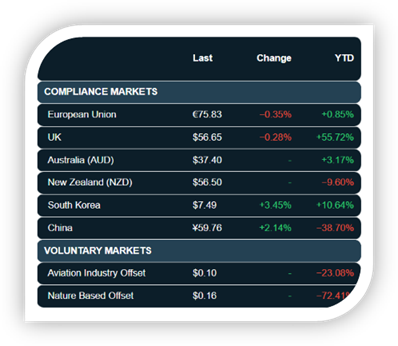
The price of carbon credits is far higher in compliance carbon markets [12]
Do You Have to Pay Tax on Sale and Purchase?
At date of this post, in the UK the sale of carbon credits is taxable for value-added-tax (a sales tax at 20% of the before-tax price) and is tax deductible from profit if the purpose of buying the credits is to increase sales of your companies goods and services [13]. In the USA, carbon credits need to be positioned as an ordinary business expense to be tax deductible, while in Australia carbon credits are tax deductible at the time of sale but in these countries a company may not have to pay sales tax. The tax treatment of carbon credits changes over time and can get very complex.
Why do it?
Even the basics sound incredibly complicated. Companies that are known high polluters (e.g., oil, aviation, pharmaceuticals) buy carbon credits from a range of organisations that includes environmental protection organisations. But why do both of these buy and sell carbon credits?
A large part seems to be belonging and maintenance of power. Greenwashing is a human endeavor and part of belonging. This becomes apparent in the use of carbon credits. For instance,
- ‘showing off’ by using symbols of inclusion such as claiming ‘net zero’ or ‘carbon neutral’ because you used carbon credits to break-even on your pollution ledger;
- trying to be liked by claiming what has been done by buying credits in ‘poor’ countries or in projects that claim to help vulnerable groups;
- or buying carbon from forest projects that store carbon for a limited time but hiding the fact that its not the temporary carbon in a project that matters, rather total atmospheric carbon over longer-than-human lifetimes.
These are some of the ways that carbon credits can be used in greenwashing in service of belonging.
At the same time, carbon credits also enable control of symbolic and financial capital. The pursuit of carbon credits as a climate change strategy internationally diverts attention from inequitable practices that result in ecological destruction. And by holding onto resources, processes, products, services, that are deeply polluting, organisations can hold onto economic power as well as access new markets for green products and services while gaining a cost advantage.
And so…
Superficially, carbon credits can seem like a win-win: companies and organisations that over-pollute collaborate with those that under-pollute and taken together, their combined pollution gets to a break-even point. And if all of these companies and organisations are also cleaning up their act while doing so, what’s not to love?
However, even a basic Q&A shows that carbon credits are heavily dependent on transparent and reliable governance in both compliance and voluntary markets. And governance varies greatly between the EU (historically strong on regulation, legislation, and enforcement) compared to say Indonesia, which is historically weak on these.
Carbon credits could be a viable new income stream for a company/organisation that is grant dependent. But they seem risky:
- ethical risk to reputation of a genuine green committed organisation;
- risk of losing your financial investment if climate heating is unchecked for instance, your carbon removal asset is burnt down in wildfires;
- great risk of diverting attention from reducing and avoiding total atmospheric carbon and equivalent gases.
World Bank considers carbon credits an innovative solution to the climate crisis and need to reduce pollution while turning a profit. That sounds like instrumental innovation at best, goal-focused on developing ‘solutions’ that address market failures and reduce public spending within existing power structures and relations of production, with the ultimate aim of preserving existing power relations…. the power relations that helped get us to a sustained period of global temperatures of 1.5°C above the estimated the pre-industrial average.
A different post takes a deeper dive into what carbon credits may be really working at.
References
[1] Innovate4Climate https://www.innovate4climateconference.org/event/Innovate4ClimateConference/Home
[2] Trouwloon et al (2023) Understanding the Use of Carbon Credits by Companies: A Review of the Defining Elements of Corporate Climate Claims Global Challenges https://doi.org/10.1002/gch2.202200158
[3] World Bank (2025) State and Trends of Carbon Pricing 2025. Washington, DC: World Bank
[4] Royal Society for the Protection of Birds https://www.rspb.org.uk/helping-nature/what-we-do/influence-government-and-business/nature-and-climate-emergency/carbon-credits
[5] Probst et al (2024) Systematic Assessment Of The Achieved Emission Reductions Of Carbon Crediting Projects Nature https://www.nature.com/articles/s41467-024-53645-z
[6] Investopedia Carbon Credits What Are They, How They Work, and Who Buys Them https://www.investopedia.com/terms/c/carbon_credit.asp
[7] Self (2019) Calculating The Carbon Dioxide Equivalent Produced By Vaporising A Bottle Of Desflurane Anaesthesia https://doi.org/10.1111/anae.14802
[8] European Union, Emissions Trading System https://climate.ec.europa.eu/eu-action/carbon-markets/eu-emissions-trading-system-eu-ets_en
[9] The Gaurdian (2023) “Revealed: More Than 90% Of Rainforest Carbon Offsets By Biggest Certifier Are Worthless, Analysis Shows” https://www.theguardian.com/environment/2023/jan/18/revealed-forest-carbon-offsets-biggest-provider-worthless-verra-aoe
[10] CarbonWatch (2025) Behind The Green Curtain: Big Oil And The Voluntary Carbon Market https://carbonmarketwatch.org/2025/02/12/behind-the-green-curtain-big-oil-and-the-voluntary-carbon-market/
[11] Allied Offsets https://alliedoffsets.com/pricing-activity/
[12] Carbon Credits (25.9.2025) https://carboncredits.com/carbon-prices-today/
[13] UK Government Revenue And Customs Brief — VAT Treatment Of Voluntary Carbon Credits https://www.gov.uk/government/publications/revenue-and-customs-brief-7-2024-vat-treatment-of-voluntary-carbon-credits/revenue-and-customs-brief-vat-treatment-of-voluntary-carbon-credits
[14] Santa Clarita Signal (2020) Kaiser Permanente Becomes First Carbon-Neutral Health System In The U.S https://signalscv.com/2020/09/kaiser-permanente-becomes-first-carbon-neutral-health-system-in-the-u-s/
[15] Bayer (2023) Bayer’s Offsetting Approach https://www.bayer.com/sites/default/files/2023-02-01-com-offsetting-publicationv4.pdf